



Excel At Life
Contents
About▼
Articles▼
Audios▼
Questionnaires▼
Topics
Excel At Life, LLC,
Missouri, USA
Site Last Modified: January 14, 2024
















Popular Articles
Crazy-Makers: Dealing with Passive-Aggressive People
Why Are People Mean? Don't Take It Personally!
Struggling to Forgive: An Inability to Grieve
The Secret of Happiness: Let It Find You (But Make the Effort)
20 Steps to Better Self-Esteem
7 Rules and 8 Methods for Responding to Passive-aggressive People
What to Do When Your Jealousy Threatens to Destroy Your Marriage
Guide to How to Set Achieveable Goals
Catastrophe? Or Inconvenience?
Popular Audios
Audio Version of Article: Crazy-Makers: Passive-Aggressive People
Audio Version of Article: Why Are People Mean? Don't Take It Personally!
More PsychNotes: Cognitive Behavioral Therapy (CBT)
Is this Just Creepy or What? Or, Why Privacy is Important
by Monica A. Frank, PhD
Time for a rant. Most of the time my rants are about media (including social media) influencing our emotions so as to make money. What I found when I rant about that (see: Facebook PsychNote) most people just didn't care. Today my rant is about our willingness to give up our privacy to corporations so they can make money. And I'm sure the response will be about the same: “Look what we get for free. It's convenient to let Amazon into my home. It doesn't matter how much it knows about me.”
I know I will sound paranoid to some but as I always told my clients, “There is a difference between being suspicious and paranoia. One is based in reality and the other is not.” However, the question is “Who determines reality?” Usually it is the majority so when someone speaks up who is not aligned with the majority they are deemed paranoid.
So be it. As an app programmer/developer I think I know better than most how data is collected about us and how much companies know about us. I recently took an online course on website hacking (to know more about making my website secure) and it was absolutely terrifying from the perspective of a consumer/user of online products.
Anyway, to my main point. Recently, I was thinking of attending a Google developers Meetup. It was about Cloud Next. Not being clear about the topic and whether I wanted to attend I googled “What is cloud next?” Now, mind you, I did not sign up for anything. I did not indicate I was going to attend the meeting. I did sign up through Meetup.com to join the Google developers group but Meetup doesn't have my address. All I did was google “What is cloud next?”
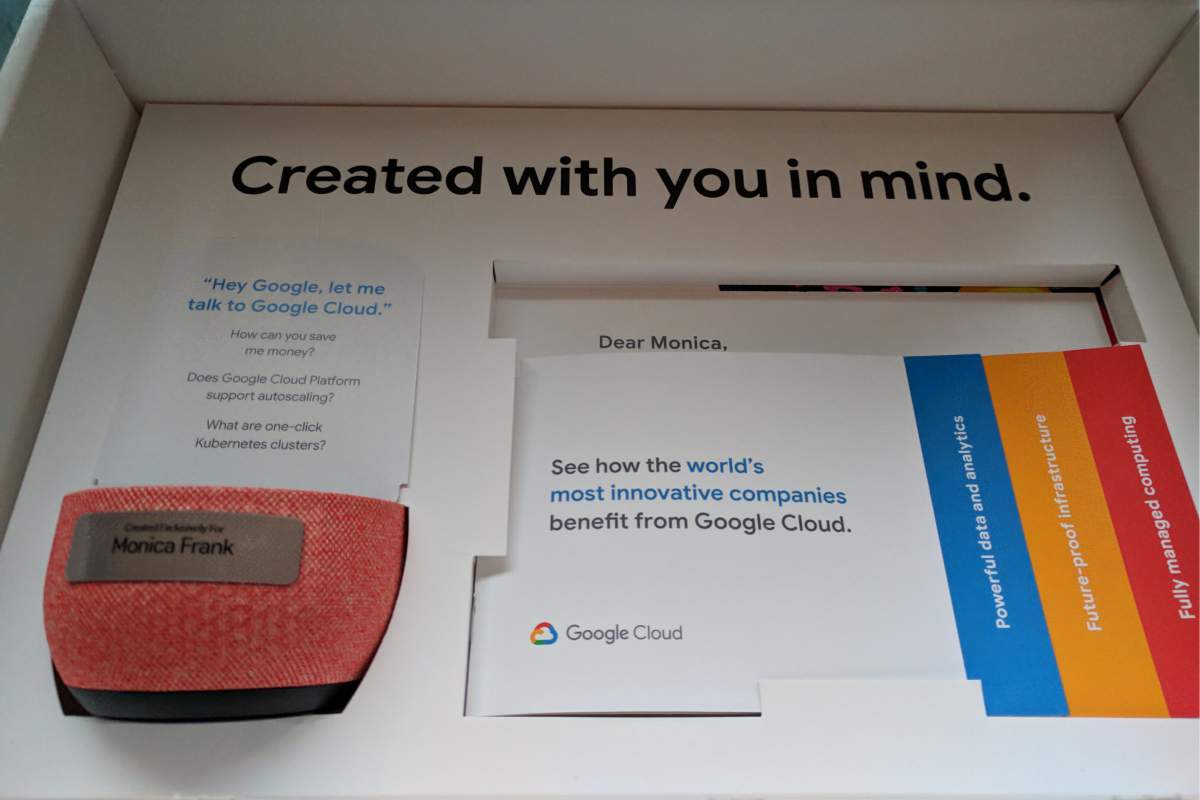
A week later I received a box in the mail (see picture) inviting me to a personal consultation about Google Cloud Platform for which I would receive a free Google Home (to go with the personalized base in the box). So sending me a box because I used Google Search isn't enough, they also want to be in my home to collect more information about me? I think not.
Of course, it is my fault. Using Chrome and Google Search is so convenient. Amazon knows what I want before I know. Giving up a little privacy isn't too much to ask, is it? I didn't think so, either. Especially since I'm an Android developer, Google probably knows everything about me already. But this just was too much for me. I think I'm switching to DuckDuckGo for my search engine.
Why is privacy important from a psychological perspective?
1) Resistance to conformity. People who are being monitored by the group are more likely to conform. Outliers are more likely to be socially punished. We may be more willing to go against our principles and what we believe is true when we are being watched (based pn Solomon Asch's experiments in the 1950s). Some people may not believe this is a problem especially those who want to control the masses.
2) Maintaining sense of self. Even more troubling than conformity is that when a person publicly conforms to something they believe is untrue they are more likely to believe that untruth in the future. This is due to the concept of cognitive dissonance which is mental distress caused by holding conflicting beliefs. As a result of the mental discomfort, the person is more likely to choose to believe what they stated publicly. This erodes the sense of self as the person doesn't hold firm personal convictions but is swayed by the crowd.
3) Gradual self-disclosure. The development of relationships traditionally has involved gradual self-disclosure that is reciprocated by others who have an interest in pursuing a relationship. This is a give-and-take process that allows a person to develop a rapport with another while assessing whether the relationship is desirable. What happens when all this information is available at the beginning of a relationship? Information is out-of-context. A person may form an opinion of you based on a social media profile that may not accurately reflect how you are when engaged one-on-one. Decisions about relationships are made without truly getting to know someone.
Permission to post this article is granted if it includes this entire copyright and an active link.